Stop the Revenue Leak: Recover 3-7% of Top-Line Revenue in14 days

Most payment systems operate with a “Legacy Tax” – hidden inefficiencies in authorization routing, checkout friction, and bloated interchange fees.

We don't just find the debt – we architect the recovery.

Calculate Your Leakage

The Strategic Pillars

Legacy payment stacks weren't built for the speed
modern commerce demands. Our modular API roadmap slots in without rebuilding everything from scratch. Live in under 14 days and delivers a measurable 20% lift in conversion velocity where friction used to live.

1
Recover Lost Transactions
Stop False Declines (2-5% rejection audit).
2
Eliminate Interchange Bloat
Save up to 1.1% per transaction.
3
Modernize the Money Flow
Modular API roadmap. Time to Impact < 14 days.

14-day Execution Roadmap

Days 1-2
Discovery Phase
Analysis of decline codes, processor margins, and current business model.
Days 3-5
Evaluation Deep-Dive
Mapping of current technical debt and friction points in the payment flow.
Days 6-10
Solution Pivot
A "To-Be" technical diagram showcasing API-first modernization.
Days 11-14
Executive Roadmap
A phased execution plan to achieve the target architecture.

Proof of Execution

Real engagements. Measurable outcomes. No theoretical frameworks.

$3M
Fraud
Stopped
Neutralizing a $3M "Card Testing" Botnet & Restoring Domain Integrity
Fraudsters used a distributed botnet to validate stolen credit cards through the client's gateway, extracting $3M and threatening merchant account termination. We neutralized it in days – with zero third-party tooling cost.
Read Full Case
2x
Auth
Rate Lift
Doubling Authorization Yield via the "Identity Trinity" Refactor
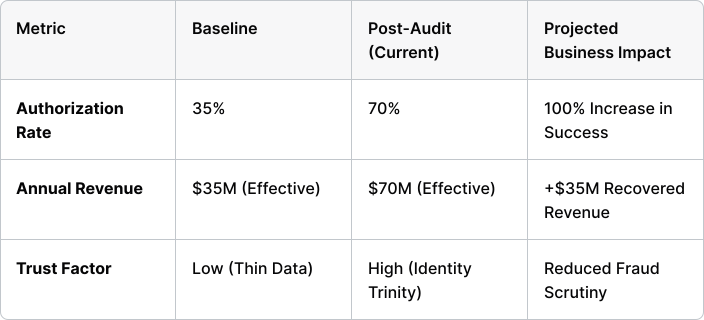
The client was stuck at a 35% authorization rate, losing $65M annually. We doubled it to 70% in 14 days through a surgical "Identity Trinity" data protocol refactor—no new vendors, no new tools.
Read Full Case
$12M
Annualized
Recovery
Recovering $12M Annual Revenue via Heuristic Rule Engineering & NL Interface
The client's global transaction success rate plummeted below 50% due to architectural drift. We built a dual-layer system: deterministic heuristic engine for precision + LLM interface for accessibility – recovering up to $12M annually.
Read Full Case

Recovering $12M Annual Revenue via Heuristic Rule Engineering & Natural Language Interface

Client: Tier-1 Subscription Enterprise
Profile: $100M Annual Revenue
High-Volume Recurring Billing
Multi-National Footprint

1. The Crisis: The 50% Approval Ceiling

The client’s global transaction success rate plummeted below 50%. This wasn't just a technical glitch; it was an "Architectural Drift." Legacy static rules were clashing with evolving bank algorithms, leading to massive revenue leakage.

The Symptom: Over $4M in monthly attempted transactions were failing without a clear "Why".

The Strategic Pivot: Our 14-day audit performed a Forensic Logic Analysis. We bypassed the surface-level "Decline Codes" to categorize failures into a binary framework: Actionable vs. Non-Actionable.

2. The FinTech Architect Intervention: 
The "Rule-Bot" System

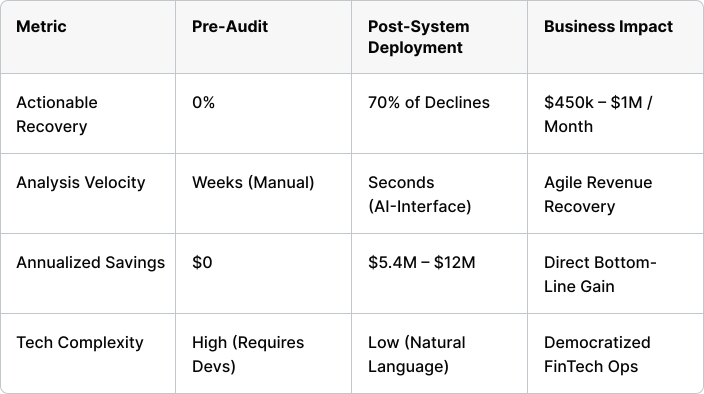
We discovered that 70% of declines were actionable. To capture this, we didn't just write new code; we built a dynamic Heuristic Recommendation Engine.

Pillar A: Deterministic Rule Classification (The "Brain"): We built a classification system using pure statistical analysis (not LLMs) to identify the "Golden Rules" for authorization.The Rationale: LLMs are prone to "hallucinations" in mathematical data analysis. We used deterministic models to identify exactly which parameters (e.g., zip code + currency + time-of-day) would flip a decline to an approval.Result: Identified core rule-sets that targeted the 70% actionable leakage.

The Strategic Pivot: Our 14-day audit performed a Forensic Logic Analysis. We bypassed the surface-level "Decline Codes" to categorize failures into a binary framework: Actionable vs. Non-Actionable.

Pillar B: LLM-Powered Strategic Interface (The "Voice")We utilized a Large Language Model (LLM) as the Interface Layer. This allowed the client’s non-technical finance team to query the complex data model using natural language.

  • The Implementation: A "Payment Architect" Chatbot. Instead of looking at SQL tables, a CFO can ask: "How do I reduce declines in the UK market for cards expiring in 60 days?"
  • The Logic: The LLM translates the question, queries our deterministic engine, and returns a human-readable recommendation: "Create a rule to route UK Visa transactions through our London entity using 3DS Data-Only."

3. The Outcomes: Recovered EBITDA

Unlike generalist AI firms that try to "solve payments with GPT-4," we use Math for the Money and LLMs for the People. We proved that a company doesn't need a team of 10 data scientists to manage a $100M money flow; they just need the right Architectural Interface.

Doubling Authorization Yield via the "Identity Trinity" Refactor

Client: Global Merchant of Record (MoR)
Profile: $100M Annual Revenue
Subscriptions & Instant Commerce
High-Volume Japan Operations

1. The Crisis: The 35% Global Approval Floor

The client was operating at a 35% success rate, effectively losing 6.5 out of every 10 customers at the final millisecond of the journey. In the Japanese market–known for its conservative banking protocols–legacy "thin-data" payloads were being auto-rejected by local issuers as high-risk anomalies.

The Revenue Gap: At $100M/year, this represented a $65M annual opportunity loss.

The Root Cause: A fragmented data architecture that failed to pass essential "Trust Signals" to the acquiring banks.

2. The FinTech Architect Intervention: High-Fidelity Data Enrichment

Our 14-day audit moved beyond code to the "Protocol Layer." We identified that the client’s legacy stack was stripping away the very data points banks use to verify human identity.

Pivot A: Solving the 3DS & Address Logic:
We re-engineered the 3DS handshake and enforced the collection of the Billing Address.

  • The Rationale: Japanese issuers (JCB/Visa/MC) heavily weight the AVS (Address Verification Service) match. Without the billing address, 3DS challenges were defaulting to "Hard Declines."
  • The Result: Immediate stabilization and a lift to a 52% approval rate.

Pivot B: The "Identity Trinity" Breakthrough (The 67% Lift)
We identified the missing link in the Japanese and International banking "Handshake": The Phone Number.

  • The Logic: We implemented the "Identity Trinity" strategy—pairing Email, Billing Address, and Phone Number in every transaction payload sent to the acquirer.
  • The Outcome: Adding verified phone numbers to the checkout flow unlocked an additional 67% lift in successful authorizations within that segment.
  • The Science: For a bank, these three points form a "Trust Triangle." When all three match the cardholder's file, risk scores plummet, and approvals skyrocket.

3. The Outcomes: Architecting the 70% Target

During our audit, we don't just look for bugs; we check your Risk Data Integrity. Most companies are "flying blind," sending incomplete data to the transaction acquirer. We ensure that every transaction carries the "Identity Trinity" necessary to turn a "Decline" into a "Deposit."

Neutralizing a $3M "Card Testing" Botnet & Restoring Domain Integrity

Client: High-Growth Subscription Platform
Profile: $100M Annual Revenue
US Market & International Presence
Subscription-Based Model

1. The Crisis: The "Silent" Reputation Decay

The client’s marketing and operations teams noticed a sudden drop in email open rates and a surge in "Spam" flags.

The Symptom: Email providers put the client’s domain under review due to spam alerts - bots were using the client's signup form to register an account and then flooded customers with emails.

The Hidden Threat: The email issues were just a smokescreen. Fraudsters were using the newly created accounts to run Card Testing Attacks, validating thousands of stolen credit cards through the accounts checkouts.

2. The FinTech Architect Intervention (The "Math-First" Audit)

Instead of buying an expensive, "black-box" AI tool that would take months to calibrate, we used Statistical Pattern Matching during our audit to surgically remove the botnet.

Pivot A: Pattern Identification & Scale Analysis:
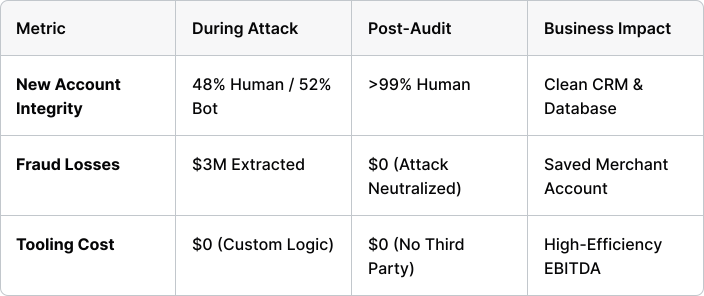
We analyzed the signup metadata and discovered that 52% of all new accounts in a 30-day window were non-human.

  • The Pattern: Bots were using a "Distributed Mesh" - varying their accounts but following a rigid signature.
  • The Discovery: These bots weren't just signing up; they were performing Enumeration Attacks, testing batches of 1+ cards per thousands of accounts.

Pivot B: Stopping the $3M "Carding" Leak:
The fraudsters had already successfully validated and extracted $3M from stolen cards using the client's gateway, putting the merchant account at risk of immediate termination by Visa/Mastercard.

  • The Technical Fix: We engineered a custom detection layer that distinguishes between the natural patterns of legitimate user input and the signatures characteristic of automated botnets. This "pattern-matching" approach allows the system to differentiate human-generated data from machine-generated strings without requiring intrusive third-party friction.
  • Result: Immediate cessation of the $3M card-testing outflow and a total stabilization of the transaction success-to-fail ratio.
  • The Differentiator: Our algorithm was Heuristic-Based. When the fraudsters changed their scheme, the "Math Fingerprint" of their behavior stayed the same, allowing the system to auto-block them.

3. The Outcomes: Business & Infrastructure Restoration

We didn't just stop a bot; we saved the client’s Merchant Relationship. If a processor sees $3M in card testing, they don't just fine you - they shut you down.

Is your email reputation or merchant account currently at risk from undetected card-testing? Let’s set up a call this week to review your flow and discuss a 14-day path to permanent protection.